
My mother grew up surrounded by jade. After decades working with the stone, she still says about 80% of what gets sold as "jade" online isn't actually jade. She's not exaggerating. The word has been used for so many different things it's almost lost its meaning.
So I wrote this guide without any unnecessary jargon nor marketing.
Why are there so many things called "jade"?
There are two minerals most people call jade: jadeite and nephrite. They're different stones, with different chemical compositions, formed in different geological conditions. Jadeite has a denser structure and tends to have more vivid colours. Nephrite is slightly softer and tends towards creamy or milky tones.
In our family we work almost exclusively with Grade A jadeite, which is the category of authentic jade with no chemical treatments. Grade B and C have been treated with acid or dyed. They're still jade, technically. But they're no longer authentic jade.
There's a bad habit in the modern trade: selling Grade B or C as if it were Grade A. If you're paying Grade A prices for something treated, you're being scammed. Plain and simple.
Where the world's jade actually comes from

The major jadeite deposits are in Myanmar (formerly Burma), specifically in Kachin State. Almost all the planet's high-quality jadeite comes from there. Nephrite, on the other hand, has been mined for centuries in Hetian, a region in western China, plus Russia, Canada, and New Zealand.
Why does this matter? Because origin affects colour purity, crystalline structure, and price. A Burmese imperial jadeite can cost ten times more than a nephrite of similar quality, even though they look alike at a glance.
We import directly. No middlemen. For years we watched each link in the chain adding margin without adding value. When you've been working with the same stone for two or three generations, you end up knowing the miners, not just the exporters.
How this stone actually forms
Jade doesn't form as a single crystal. It forms in zones where the Earth's mantle and crust meet under enormous pressure, usually in ancient mountain belts where two tectonic plates collided hundreds of millions of years ago.
That formation under pressure is what gives jade its unique hardness, and that interlocked fibrous structure that makes it nearly impossible to break with a knock. It's not crystal hardness; a crystal chips. It's the hardness of a thousand microscopic fibres working together.
On the Mohs scale, jade ranks between 6.5 and 7. In practice, that means a jade bangle survives the kind of bumps that would chip a softer stone. And there's a tactile thing the spec sheets never mention: when you hold a polished jade piece, it stays cool against your skin and feels almost soapy to the touch.
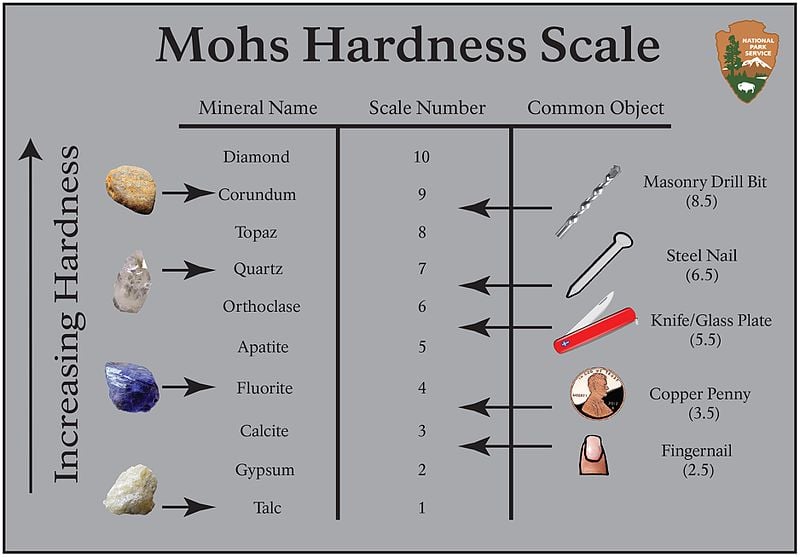

Image by the National Park Service. Public Domain.
What the colours actually tell you
This happens in the shop all the time: someone walks in, sees a piece in white or lavender, and asks "is this also jade?". Yes. Jade isn't only green, even though imperial green has taken all the attention for centuries. Since the Chinese trade of the 19th century, that one shade became synonymous with the stone. But jade comes in many more colours:
- Imperial green: high-quality Burmese jadeite, translucent, with a deep emerald colour. The most sought-after in today's market.
- White: nephrite from Hetian, known in China for millennia as "river jade." Creamy, semi-translucent tones.
- Lavender: rare, almost always Burmese jadeite, with translucent mauve tones. Each piece is practically unique.
- Black: nephrite with high graphite or chromium content, highly prized in Chinese ritual carving.
There's also grey and honey jade, plus occasional finds in red, though those are rarer pieces.

Which colour is best? Depends. For the hand and skin, white flatters cool tones, green adds contrast, lavender makes a statement piece without overdoing it. Personally I wear lavender jade on days I want something quiet but a bit different.
How to tell if jade is real
There are tests you can do yourself at home: the cool-touch test, the weight per volume, the sound when two pieces tap together, the light test. None is definitive on its own. But the combination of them works as a reliable first filter.
Professional certification is still the only 100% sure way. Every piece we sell comes with a Grade A certificate.
We'll publish a detailed guide on telling authentic jade from treated soon. In the meantime, a practical rule: if someone offers you imperial green jade for less than €200, it isn't imperial green jade.
Why the shop is in Zaragoza
We've lived in Zaragoza for more than three decades. The shop opened here for a simple reason: it's where our family lives. There was no market calculation, no chasing the city with the most tourism or the most demand. We opened where we already had a life.
My grandmother came to Spain from China a long time ago. My mother grew up in this city, and watching jade pass through her hands year after year, we ended up doing what made the most sense: specialising in what the family already knew better than almost anyone in the country.
We work with jade because we know it. It's not a catalogue choice: it's what's been through my family's hands for decades. Every piece we offer has been hand-selected at source, passed through our own inspection process, and sold without the distributor markup.

The shop is at C/ Pedro María Ric 9, between Plaza Aragón and Paseo Sagasta. If you're passing through the city, come and see it. Holding a jade piece in your hand and feeling its weight, its coolness, its texture, is the only way to understand why this stone has lasted three thousand years of culture.
If you're looking for something one-of-a-kind, we also design made-to-order jewellery. We work with jade, diamonds, solid gold, sapphires, aquamarine, and other fine stones.
Jade doesn't need any more legend than it already has. What it does need is for us to stop selling it as if all grades were the same thing.
You can browse our full collection or read more about authentic jade in Spain.